
Where could your skills make the biggest difference this year?
Picture it: the funding application you help write on a Tuesday morning can become, a few months later, the walls of a school. That is the project — the Bégbé school building — that Valentina, Sandrine and Manchita worked on.
✓ A mission shaped with you, around your skills and your dates
From 2 weeks
up to 6 months or more
See the grid
contribution to costs: housing, meals, supervision
6 fields
projects, funding, communication…
2015
association founded
On the ground, in pictures
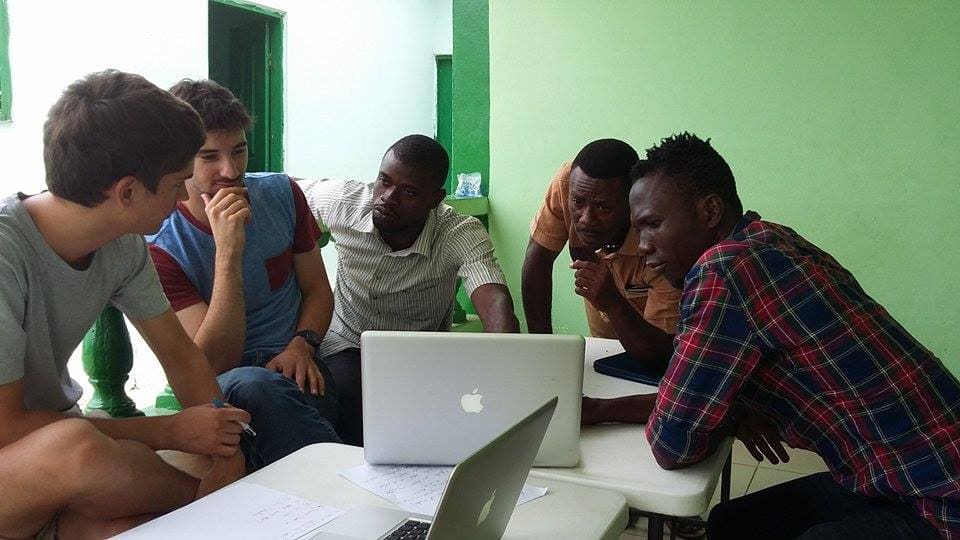
Lomé, Togo · June 2016

Why capacity building
Because a strong organisation helps for longer
A school, a health centre or a tutoring programme lasts when the local team knows how to fund, manage and promote it.
By passing skills on, not doing it for them
You work alongside the Togolese team, on its priorities: what you bring stays when you leave.
A capacity-building mission
Project management, fundraising, communication, accounting, training — often in the mornings, with tutoring in the afternoons if you wish.
Your skills, their needs
Six concrete ways to strengthen the association. You offer, the team guides.
Project management
Structuring a project, building a budget, keeping to a schedule, writing the reports partners expect.
Fundraising
Finding funders, writing applications, approaching companies and foundations — as Valentina did with Togolese companies and banks.
Communication
Social media, photo, video, website, print: making the work known in Togo and in Europe.
Accounting & admin
Tracking sheets, records, procedures: getting things in order to earn funders’ trust, as Sandrine and Manchita did.
Team training
Passing on know-how: office software, management, facilitation, languages.
Field study
Investigating, analysing, recommending: in 2016, business students Mélissa and Adam carried out a decisive study to choose the association’s next major project.
What this mission will teach you
- How a field study by two students weighed in the choice of the association’s next major project.
- Why a good funding application often starts with a meeting with the village development committee — Sandrine and Manchita went.
- How a blog and a German regional newspaper can make a Togolese building project known thousands of kilometres away: Valentina’s method.
- What happens to your tools when things must be simple, robust and lasting — the skill recruiters call “adaptability”.
- Why you will come home with concrete proof for your CV: an application, a plan, a tool still used after you leave.
- Where to find the best balance: association work in the morning, the tutoring children in the afternoon.
A mission week
A rhythm designed to move fast without losing touch with the field.
Monday
Team meeting
The week’s priorities with the Togolese team: what really matters to the association.
Tuesday → Thursday
Working mornings
Your mission: application, communication plan, tracking sheet, training…
Afternoons
Field and children
Tutoring, project visits, meetings with partners, depending on the mission.
Friday
Review
What has been achieved, what is left, what the team takes over.
Weekend
Discoveries
Markets, beach, excursions: Togo, differently.
Indicative rhythm, shaped with you according to your mission and its length.
They did it
After a disappointing first experience elsewhere, she finally feels considered a full member of a team, and can reach the goal she set herself on arrival: to contribute to the association’s development.
For you if…
- You are a professional who wants to give meaning to your skills — during holidays or a career break.
- You study management, communication, finance or development and are looking for a placement, gap year or field study.
- You are recently retired and your experience can still save a team years.
- Your employer supports skills-based volunteering: talk to us and we will shape the mission with them.
- You speak French and are happy to live simply, in a community.
Companies: skills-based sponsorship
An employee who strengthens an association takes a skill to a new scale — and brings back a powerful story to share internally. We design the mission with the company: goals, length, deliverables, attestation.
Your contribution to costs and what it covers
A simple, transparent contribution to costs, the same as for other missions.
| Length | Mission or internship | Work camp |
|---|---|---|
| 1 week | 125 € | 130 € |
| 2 weeks | 200 € | 210 € |
| 3 weeks | 275 € | 290 € |
| 4 weeks | 350 € | 370 € |
| 8 weeks | 650 € | — |
| 12 weeks | 950 € | — |
Registration €50 ; staff support mission / health internship: €75 per week ; work camp: €80 per week
What your participation covers
- Preparation of your mission, and an accommodation certificate for your visa application
- Pick-up at Lomé airport and transfer to your accommodation, on arrival and departure
- Accommodation in the Midezon House (shared rooms)
- Three meals a day at the mission site, and bottled water
- Support from a mission coordinator and the local team
- Lomé discovery day, welcome and farewell parties
- Someone to take you to hospital if you fall ill
- Mission attestation, issued on request
Not included
- Flights, visa and passport
- Vaccinations and malaria prevention
- Travel and repatriation insurance
- Any medical or hospital costs
- Daily trips (motorbike taxi) and personal transport
- SIM card and data plan
- Excursions and outings (including the volunteer guide’s costs)
- Meals away from the mission site, personal spending and souvenirs
The €50 registration fee is paid once and is non-refundable.
For departures from 1 January 2027: new contribution.
Our contribution had not changed since 2015. Since then, the cost of living in Togo has risen sharply: minimum wage +50% (2023), petrol +31% since 2022, electricity +12.5% (2025). This update lets us keep welcoming you well and fund our projects on the ground.
Registration €90 ; staff support mission / health internship: €375 flat for 1 to 3 weeks, then €75 per week ; work camp: €375 flat for 1 to 3 weeks, then €80 per week.
Where your contribution goes
Your contribution to costs does not buy a stay: it covers the expenses incurred for you, before and during your time in Togo. Whatever is left at the end funds local projects.
Before your stay
Your file and the paperwork: exchanges with the team, the accommodation certificate for your visa application, the letter of acceptance and the documents your school asks for an internship.
During your stay
Accommodation, three meals a day, water and electricity in the house, supervision by a coordinator and the local team, local transport organised by the team for the mission (airport pick-up included).
At the end of your stay
If anything is left, it funds local projects, for example after-school tutoring: chalk, school supplies, repairing desks.
A contribution to costs is not a donation: it never entitles you to a tax receipt. How contributions are used →
Four steps to go
- 1
Describe your skills
In the registration form: your job, what you can do, your dates.
- 2
Let’s shape the mission
A video call to match your skills with the association’s priorities and agree a deliverable.
- 3
Prepare your trip
Visa, vaccines, budget: the departure guide walks you through it.
- 4
Pass it on
On site, with the Togolese team. You leave; the know-how stays.
Skills-based volunteering: frequently asked questions
What is capacity building?
Helping an organisation work better on its own: managing projects, finding funding, communicating, keeping accounts, training its team. The aim is not to do it for them, but for the know-how to remain after you leave.
Which skills are most useful?
Project management, fundraising, communication (social media, photo, video, web), accounting and admin, training, field studies. Not sure? Describe your job: the team will tell you where it helps most.
How much does a skills-based mission cost?
The contribution to costs (registration included) is given in this page’s grid and covers housing, meals, supervision and airport pick-up. It is not a donation and does not entitle you to a tax receipt. Flights, visa, vaccines and insurance are extra.
Can my employer support my mission?
Talk to your employer: the association designs the mission with them (goals, length, deliverables) and provides the necessary documents, including a mission attestation.
Can it count as my internship or field study?
Yes, if your institution agrees: send us your agreement form and the team will review it with you.
How long should I plan for?
From 2 weeks for a focused mission; 4 to 6 months to run a project from start to finish, as Valentina, Sandrine and Manchita did in 2017.
Updated on
Your skills are worth more than a line on a CV. Give them a second life.
Describe what you can do: the team gets back to you to build a useful mission that fits you.